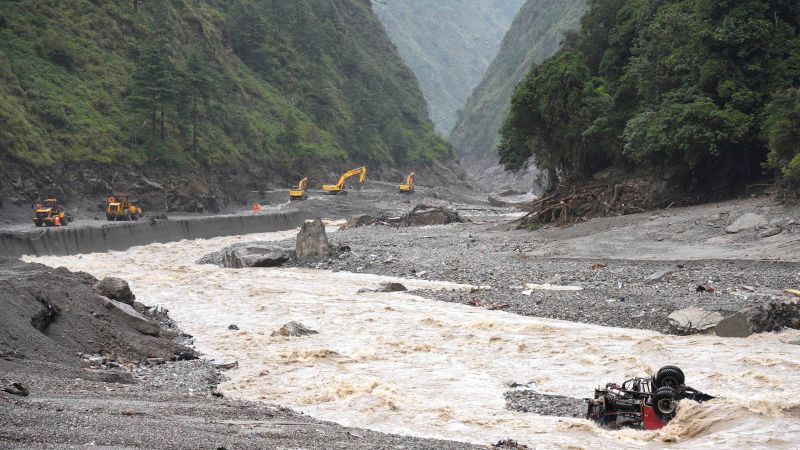
Rescue teams are racing against time along the border of Nepal and China after catastrophic flash floods left a trail of devastation and a growing death toll. Official figures show more than 670 people dead in Nepal and at least seven in China, though those numbers are expected to climb as recovery efforts continue. Roughly 3,000 people remain missing, including hundreds of hydropower workers trapped in tunnels and remote sites that have proven nearly impossible to reach. With nighttime falling over the rugged terrain, helicopter operations have been forced to pause, leaving rescuers and families in a state of agonizing suspension.
On the ground, the scene is one of absolute ruin. Survivors are returning to mud caked remnants of their homes, sifting through debris for any surviving belongings. Small moments of heartbreak and hope define the landscape, from a child’s discarded toy bunny found at a Chinese border crossing to the dramatic rescue of six year old Manisha, who was pulled from a collapsed building after several days. Despite these glimmers of survival, Nepali authorities are struggling to manage the sheer volume of casualties as loved ones crowd medical centers and morgues every day, desperate for any piece of information about their kin.
The tragedy has reached far beyond the borders of Asia, sparking international alarm as families in the United States and Canada wait for news of missing travelers. Among them is a group of ten American men on a hiking trip toward Mount Kailash who vanished when communications suddenly went silent over eighty hours ago. Their wives and children are now pleading for answers, fearing that age and medical needs may make the lack of shelter fatal for some in the group. For these families, the silence is unbearable, turning what was meant to be a celebratory vacation into a nightmare of uncertainty.
Experts suggest that this disaster may have been triggered by glacial lake outburst floods or sudden glacial failures, which occur with such speed that traditional warnings are often useless. This volatility makes the search even more perilous for the 9,000 Nepali Army personnel deployed to the region. As they battle heavy rains and treacherous altitudes to locate survivors, the global community watches a region stripped bare by nature’s violence, where entire towns like Trishuli Bazar have simply been swept away by the current.